From Babylon to Berlin: ANES Museum Tour of Europe
ANES Museum Tour of Europe
Join us in the British Museum in London, the Louvre in Paris, and important museums in Berlin and Munich. We will then travel to Greece, where we will enjoy the sites and museums of Athens and visit Delphi, Corinth, and Eleusis. Our study abroad will end in Rome, where we will spend a day in the Vatican Museums and see the Sistine Chapel and St. Peter’s; spend a full day in the Forum and visiting other ancient Roman sites; and then spend half a day in the catacombs before going to the important ancient port of Ostia. #BYUAbroad #BabylontoBerlin #BYUANES
Wednesday, June 21, was a very full day. I got up at 5:15 a.m. and went for a run. After breakfast with the group at 7:00, we were out the door at 7:40. We were out all day seeing the primary sites of Classical Rome and then did not get home from our group dinner until after 10:00 p.m. One of our students found on her phone that we had walked a total of 14 miles!
I got back to my room, got ready for the next day, showered, and dropped, breaking my streak of blogging every day. It is now early the next day and I am scrambling to get ready for another day, so I am going to simply post my Instagram collages so readers can have an idea of what we did. Hopefully I can come back later and expand this post with more high res images and some explanations.
The Flavian Amphitheater (a.k.a. the "Colosseum")
The Arch of Titus
The Roman Forum
The Palatine Hill (Imperial Palaces)
The Circus Maximus
The Capitoline Museum All photos for educational purposes only
We needed to start early this morning, very early to get to the airport in Athens in time to meet our flight. The hotel prepared a light breakfast at 5:30 a.m., and our trust driver Yannis picked us up right at 6:00 a.m.
There were a couple of glitches checking in but nothing of Munich magnitude (where, regular readers may recall, difficulty paying bag fees for the students meant that I almost did not make the flight). I cannot tell you much about our trip from Athens to Rome because I was asleep for almost all of it. I do not even have a picture from the plane to share.
A coach picked us up at the airport in Rome and took us to our hotel, where we were able to check in soon after we arrived at noon. Some went out to get something to eat; many napped.
We finally got going at 3:00 so that we could use the late afternoon and early evening not so much for a city orientation as I have done before but rather for a collection of quick sites that were conveniently together in north-of-central Rome.
The Ara Pacis and the Mausoleum of Augustus
Our students "casually" gathering for a photo in front of the Ara Pacis
We took a bus across the Ponte Cavour to two monument—one reconstructed and one only roughly excavated and now being renovated—that were both closely connected with the emperor Augustus. This was exciting for me, because one of the focuses of my ancient history graduate degrees was Roman imperial history and I taught Classics at BYU from 1994-2003 before I transferred to Ancient Scripture.
Augustus, his family, and his associates did a lot of building in this part of Rome, in a region that anciently was called the Campus Martius. The first of two that we saw today was the Ara Pacis, an altar to personified Peace, who here was closely associated with the emperor himself. The idea is that Augustus' rule had restored peace after generations of civil war, and that, in turn, had restored fertility and prosperity to Roman and the empire.
The altar's original location in the Campus Martius was next to the Horologium, a massive sundial, and on Augustus 23, Augustus' birthday, the shadow of the Egyptian obelisk that served as the sundial pointed at the altar, indicating that the birth of the future emperor brought the promise of peace back to the world.
Bucrania, garlands with leaves, flowers, and fruit strung between the skulls of sacrificial oxen, are an important symbol of fertility.
It was inaugurated in 9 B.C. on January 30, the birthday of Augustus' wife Livia. Indeed, the altar celebrated not only Augustus' contributions to Rome but connected his wife and his extended family to the well-being and prosperity of the empire. This was done by portraying the family in the sculptural program of the screens that surrounded the altar, that linked them with the mythical past and current public celebrations.
A relief of Aeneas, legendary founder of the Julian family and and ancestor of Rome's founders, sacrifices as did Augustus, the second founder of Rome. This panel appears over a lower panel representing the prosperity of the Augustan Peace.
With Rachel under the Tellus Relief. The "Tellus" figure, representing fertility, could be Mother Earth, Ceres (Demeter), a personification of Italy, or the empress Livia.
I spent years of my life studying this lady.
One of the side panels that depicts members of the imperial family, including its children, in a procession of public officials and religious figures.
[Livia, some of you may recall, was the subject of my doctoral dissertation].
There are probably not many study abroad groups that need to humor their director by posing in front of Augustus' Res Gestae!
Outside of the modern museum housing the reconstructed altar is a wall of modern carvings containing the text of the Res Gestae, Augustus' own account of his achievements that he had placed on two panels outside of his mausoleum.
The remains of the Mausoleum of Augustus
The remains of this very mausoleum lie due east of the modern museum. In antiquity it was a massive artificial mound that had burial chambers within and cypress trees and statues on top. Many members of the imperial family and some later emperors up to the time of Nerva were buried here. I was pleased to see that some new excavation and renovation seem to be going on.
Possible reconstruction of the Mausoleum of Augustus. See http://www.thehistoryblog.com/archives/47110
Other side viewed through the window of the Ara Pacis Museum.
The Pantheon
While my students were subjected to perhaps some involved Roman historical lectures with the first two sites, the rest of the evening was largely fun, walking from site to site with my giving just a little background.
I managed to get in this picture.
Well sometimes a bit more background, at least in the case of the iconic Pantheon. This temple to multiple (later thought to be "all" the gods) gods was an originally a private religious structure (Latin, sacrata privata) built by Marcus Agrippa, Augustus' best friend and later son-in-law. It was later renovated and perhaps expanded by Domitian and was built in its stunning current form by the emperor Hadrian, who nonetheless kept the attribution to Agrippa.
Other quick stops
Rome is such a wonderful city to walk through. In addition to iconic sites such as the Trevi Fountain or the Spanish Steps, monuments from Roman antiquity might appear around the next corner. If not, just the scenes the streets present are amazing. And of course, there is the food . . .
The Obelisk of Augustus and the Column of Marcus Aurelius
Our group together with our local guide, Sophia Gridaki, at the Temple of Apollo in Delphi.
Today we had a bus tour that took us first Delphi and then to the Byzantine monastery of Hosios Loukas. It took several hours to get to these sites in central Greece, but the countryside was gorgeous, and Sophia had many interesting things to tell us along the way about the history and culture of the areas through which we passed.
The Greek countryside, here seen at Diostomo, where we visited the monastery of Hosios Loukas.
[Disclaimer: This post will likely have less background and explanation and perhaps more of my Instagram collages. Between our spotty hotel internet, which slows photo uploads, and the need to pack before a very early departure, I simply do not have the time that I usually invest in these entries. Still, I want you to see these great sites!]
Delphi
As Sophia explained it to us, "The Ancient Greeks could read a site like a book." They certainly chose a stunning locale, where the treasuries, temple, theater, and stadium of Apollo all ascended up the side of a picturesque hill.
An early Bronze Age site dedicated to the ubiquitous Mother Goddess, Delphi later become sacred to the god Apollo, a shift alluded to in the second part of the Homeric Hymn to Apollo. A god of light, music, poetry, intellect, and culture, Apollo also revealed the will of his father Zeus to mortals. Accordingly this particular sanctuary became the seat of one of the foremost oracles of the ancient world, where pilgrims and delegations would visit the Pythia, the female prophetess of Apollo whose ecstatic utterances were rendered into poetic, often ambiguous, oracles by the shrines priests.
The Tholos and site of Athena Pronaios
Before visiting the main precinct of Apollo, we stopped at the lower sanctuary of Athena Pronaia (Athena-before-the-sanctuary). Both her archaic and classical temples lie in ruins, but the tholos, or round structure, that lay between them was certainly stunning.
The restored Athenian Treasury at the lower level of the Delphic sanctuary at the top left; the theater and main temple viewed from above in the center; and some of our students at the upper hippodrome, or stadium.
After several days of rain, the skies around Delphi were truly stunning today.
Today the site also boasts an impressive and well-curated archeological museum that contains many artifacts found here from almost every period. Perhaps the most famous, of course, is the bronze Charioteer of Delphi.
After we left the site, we drove into the modern town of Delfi, where we had another delightful lunch.
Hosios Loukas
Later in the afternoon, we drove to Hosios Louikas, a Byzantine monastery from the tenth century near Diotismo on the slopes of Mount Helikon (where, according to legend, the poet Hesiod had his "first vision" of the Muses). The mosaics were stunning, and our visit gave Sophia (and to a lesser extent me) a chance to talk to the students about Greek Orthodoxy and the history of Greece in the Middle Ages and early modern period.
Upon our return to Athens, we bid farewell to our friend Sophia and our trusty driver, Yannis.
[When I have better, faster internet and more time, I hope to return to this entry and upload more higher resolution, single images. Thank you for your patience.]
A Last Greek Dinner
I had hoped to take my daughter, Rachel, to one of my favorite places to eat in Athens, Orizontes on Mount Lykavittos. But we did not have time, so we still managed to get some mixed grill, and I some χταπόδι (octopus) at a restaurant not too far from our hotel.
One of us is more excited about eating grilled χταπόδι (octopus) than the other!
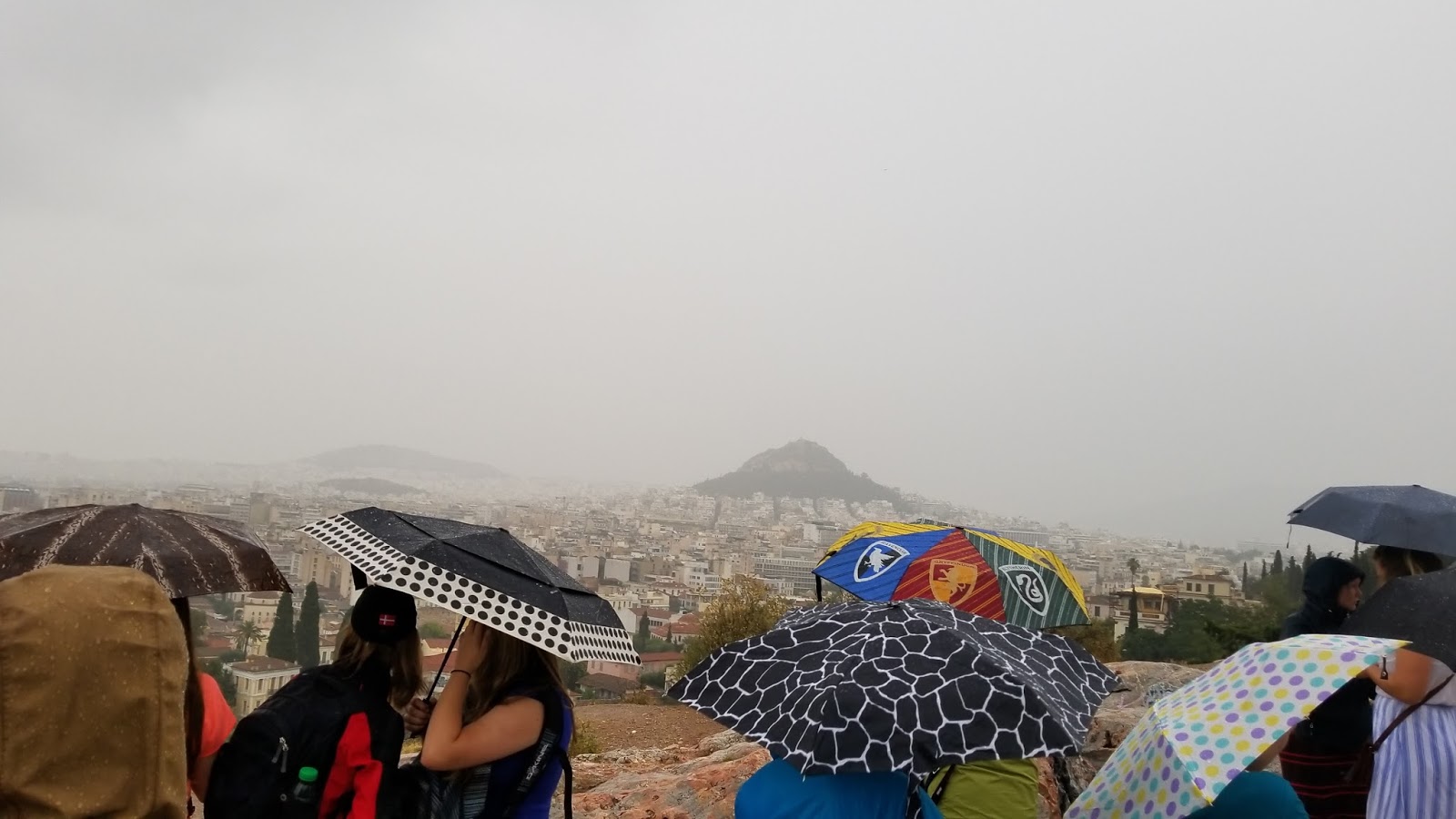
Standing in front of the Areiopagos (Mars Hill) this morning in the falling rain.
One of the hashtags that I used on all but about two of my social media posts today was #rainyathens.
The cloudburst that we had on the Filoppapos Hill at the end of our orientation walk Friday did not turn out to be the last rain that we saw. After hot, pretty clear weather for most of the day yesterday, another rainstorm hit in the evening just as most of us were walking around Athens for free time. Then, despite my hopes, I woke to find it raining this morning for our only full day in the city.
I can hardly tell you how unusual this is. Like many countries bordering the eastern coasts of the Mediterranean Sea, Greece receives most of its rain in the winter months and early spring. It was a bit rainy in the northern part of the country when I was here with my Alcuin Fellowship in 2010, but I have never known it to rain much when I have been in Athens during the summer. So far, it has rained every day we have been here.
While this slowed us up some, it did not stop us. We were able to do almost everything we had planned, though some of the extra time it took us to get around and a surprise change of time for sacrament meeting did mean that we ended up missing our appointment for the National Archeological Museum this afternoon (even though that was, ironically, an indoor activity).
Morning Devotional on Mars Hill
Our plan was to start our Sabbath early with a sunrise devotional on the Areopagus, which is called "Mars Hill" in the KJV of Acts 17. This is where the apostle Paul was brought to explain his early preaching here in Athens and where he delivered his famous speech on "The Unknown God." Climbing the rock, I read from Acts 17, interlacing the passage with commentary. We then sang "I'll Go Where You Want Me To God" and prayed.
"I'm preaching in the rain, just preaching in the rain . . ."
This dog met up with us as we emerged from the Akropoli metro station and then padded along in the rain with us all the way to the Areopagus. I though he deserved his own picture.
The Acropolis!
Standing in the rain before the Propylaea before the students started their self-guided tour of the Acropolis.
Akropolis means "upper city," and the Acropolis was originally the citadel of Athens. A Mycenaean palace in the Bronze Age, it went from being a fortress to a religious center in the Archaic Period, and in the Classical Period it was graced with the amazing buildings whose remains visitors see now: the Propylaea, or ceremonial gateway; the delicate temple of Athena Nike, or "Victory"; the Parthenon, dedicated to the goddess Athena in her guise as the virgin protector of the city; and the Erechtheion, an interesting structure that housed the original wooden cult statue of Athena and also contained shrines to Poseidon, the legendary king Erectheus, and another local hero.
The small but beautiful temple of Athena Nike perches on a bastion to the side of the Propylaea.
Yep kids, its raining
Yes, I love this place, even in the rain.
Ongoing restoration work cloaks the western face of the Parthenon in scaffolding, but it is still amazing.
With Rachel in front of the eastern side of the Parthenon.
Because I am not a licensed guide in Greece, I could not give the students a formal tour of this site. So instead the students each wrote a formal site report on the buildings of the Acropolis before we came on our study abroad so they were familiar with its history and the nature of its buildings.
The Erechtheion, which boasts the famous Porch of the Maidens and an interesting floor plan.
Looking down at the Theater of Dionysus from the Acropolis. The New Acropolis Museum, which we visited later this morning, lies behind it.
The Agora
While the Acropolis was the primary religious center of ancient Athens, the Agora, or marketplace (literally "come together place"), was the civic and commercial center of the city. Our visit here was a bit rushed as the students went through the site, seeing where ancient porticoes, honorary statues, the well-preserved Temple of Hephaestus, and the restored Stoa of Attalus are.
The New Acropolis Museum
When I first started coming to Greece, the only museum containing finds from the Acropolis was an old, low-lying building on the east end of the hill. In 2009, a spacious, modern new museum south of Acropolis was opened that contained numerous items---everything from pottery, figurines, and other small finds from the Bronze and Dark Ages to the remains of the Archaic temples destroyed by the invading Persians in 480 B.C. to the precious carvings and statues from the Classical buildings that have been moved inside for better care and preservation. Because so many of the early items have not yet been properly published, photographs can only be taken of the Classical items on the upper floors.
An interesting and wonderful feature of this museum is its upper floor, which is oriented towards the Parthenon on the Acropolis above it and holds each of the metopes, the inner Ionic frieze, and the few fragments of the pedimental sculptures in their relative positions.
The actual Parthenon can be seen through the windows.
LDS Sacrament Meeting
Yep, this week we did make it to church. Unfortunately the time posted on the internet for the English-speaking branch was not the same as when it actually met. After last week's misadventure, I was prompted to call the mission office this morning to confirm the address and time. Upside: we made church. Downside: we missed our planned visit to the National Archeological Museum. I felt bad about that, but as our guide Sophia reminded me yesterday, our groups do not know what they have missed if we do not tell them (whoops, I kind of just did).
A Few Other Sites
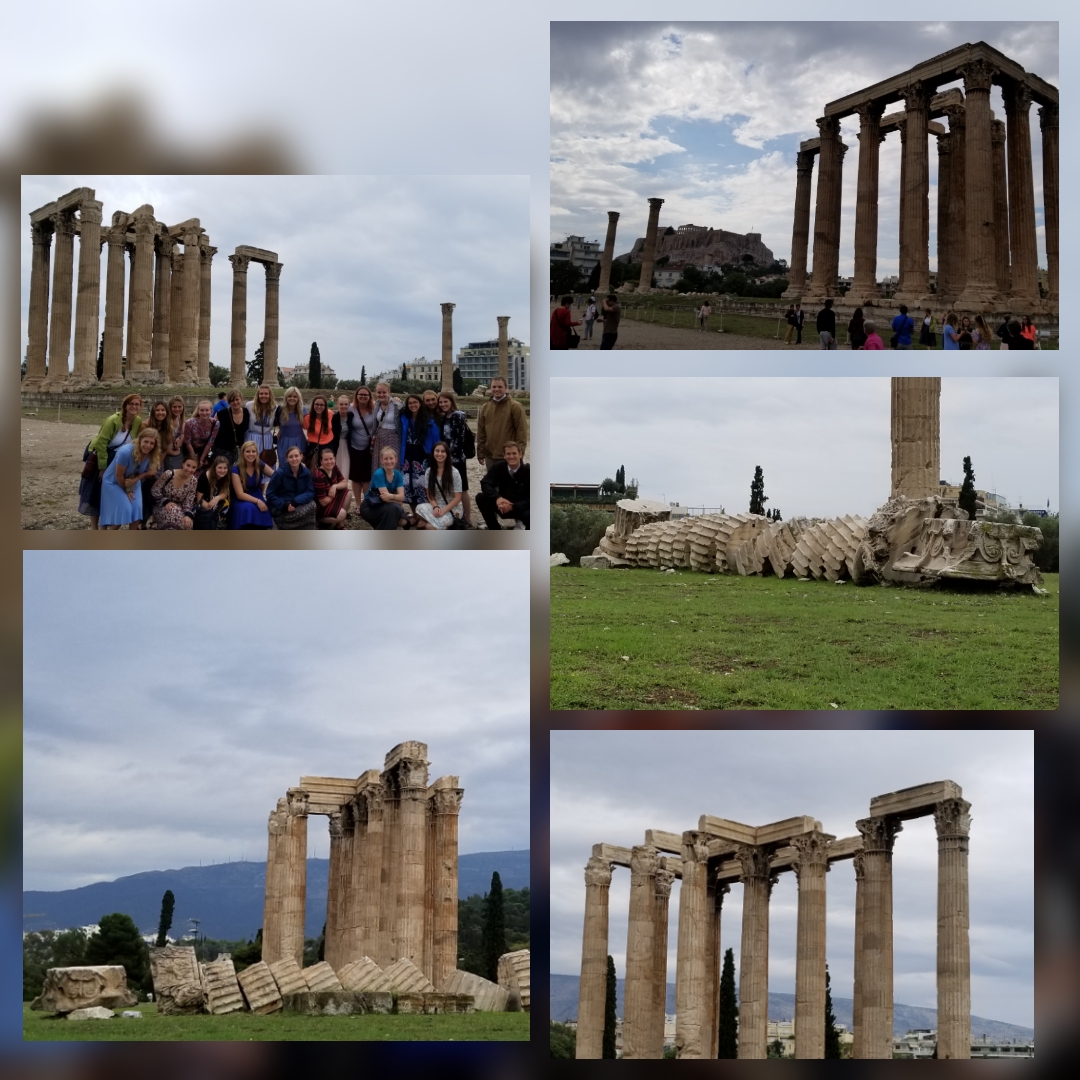
Note to self: there can never be enough time in Athens, so if you repeat this study abroad in a couple of years, add at least another day. After church and before dinner, however, we did visit the Hellenic Parliament (former Royal Palace) to see the famous guards, the Temple of Olympian Zeus, and the Arch of Hadrian. I am exhausted and it's late, so you'll need to click on the links to read the Wikipedia articles on them if you want to know more.
And once again, there was dinner . . .
We had another great meal, this time at the Ydria Restaurant in Plaka. Oh, and there may have been some music and dancing at the end.